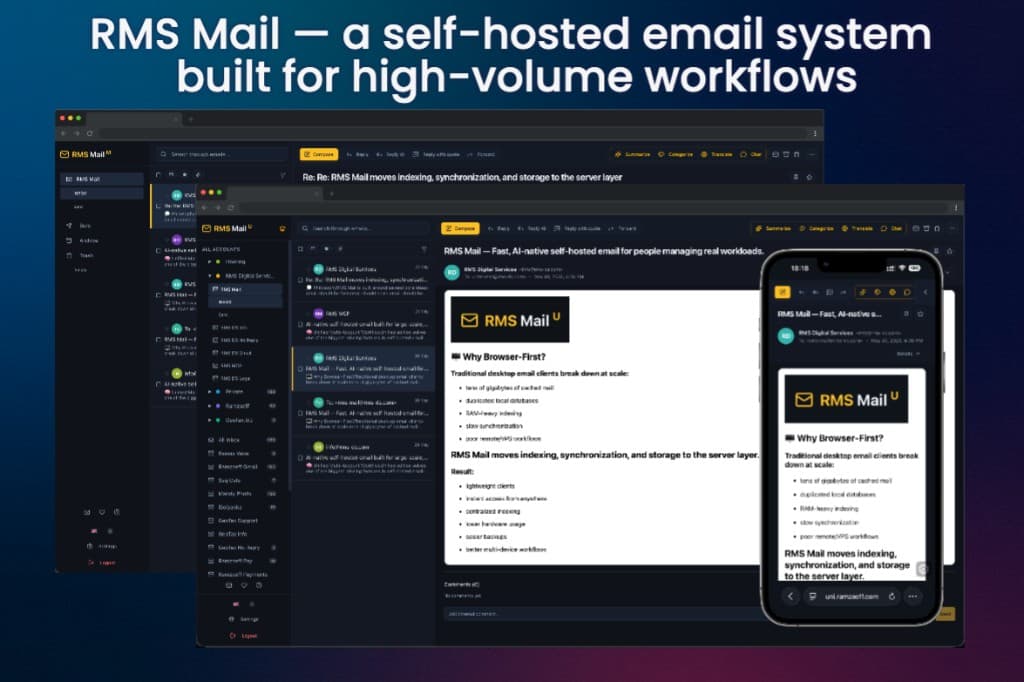

Why self-hosted mail still matters in 2026
Why companies return to self-hosted mail: data control, performance, multi-account workflows, and the role of AI.
Email remains one of the most important tools for business communication. Despite the growth of messengers, corporate portals, and collaboration systems, mail is still the primary channel for working with clients, partners, suppliers, government agencies, and internal company processes.
In 2026, many organizations face a new challenge: correspondence volume keeps growing while traditional mail solutions increasingly become a bottleneck for the business.
Why companies consider self-hosted mail
For many years the market revolved around cloud services and classic mail clients. That works well for small teams, but as the business grows, limitations become visible:
- dependence on an external service provider;
- rising subscription costs;
- storage limits;
- confidentiality requirements and internal security policies;
- difficulty managing many mailboxes;
- limited automation options.
For many companies, control over corporate mail is no longer just a convenience question — it is a question of security and business predictability.
Control over data
One of the main reasons to move to self-hosted solutions is full control over corporate information.
With cloud services, data lives on the provider’s infrastructure. Even with reliable vendors, the company must trust an external organization with storage and processing of correspondence.
The self-hosted model allows you to:
- store data on your own servers;
- define backup policies yourself;
- control employee access;
- integrate mail with internal company systems;
- minimize dependence on external services.
For organizations handling financial, legal, or commercial information, this can be a critical requirement.
Performance matters more than interface
Most mail clients are still built around IMAP as the primary mechanism.
That works for small mailboxes, but problems appear when you have:
- dozens of mail accounts;
- hundreds of folders;
- multi-year archives;
- large attachment volumes;
- heavy search usage.
Users end up with slow search, navigation delays, and limits on bulk operations.
Modern self-hosted solutions increasingly treat IMAP as a sync transport while search, indexing, and message processing run on the server.
That enables near-instant search and more predictable performance even at large data volumes.
Mail as part of business processes
Today mail rarely exists separately from the rest of the company’s systems.
Businesses need:
- messenger notifications;
- automated message processing;
- CRM integration;
- AI tooling;
- centralized search across communications;
- multi-account management from one interface.
In practice, mail systems are evolving from message readers into full communication hubs.
Working with multiple mail accounts
Agencies, outsourcing firms, hosting providers, MSPs, developers, and multi-project owners often manage dozens of addresses at once.
Classic solutions usually offer a flat list of separate accounts.
Modern systems combine them into one workspace:
- shared search;
- grouping by project;
- unified notifications;
- centralized message handling;
- shared rules and automation.
That reduces employee load and speeds up correspondence handling.
The role of AI in corporate mail
AI is useful when it helps you work with existing information flows rather than creating new ones.
The most in-demand scenarios:
- short summaries of long threads;
- search across mail content;
- incoming message categorization;
- help drafting replies;
- automation of routine tasks.
Many companies prefer their own API keys and model providers to keep control over data.
Why interest in self-hosted solutions keeps growing
Interest in self-hosted mail is driven by several factors at once:
- reducing dependence on external vendors;
- rising confidentiality requirements;
- need for integration with internal systems;
- growing correspondence volume;
- advances in automation and AI.
Companies increasingly treat mail as part of their own digital infrastructure, not a standalone service.
Conclusion
In 2026, self-hosted mail is no longer a tool only for enthusiasts and system administrators.
For many companies it is a logical step toward greater independence, data control, and operational efficiency.
Modern solutions deliver the benefits of owned infrastructure without sacrificing usability, speed, or automation.
The key question today is not whether self-hosted mail can work for business, but how well the chosen solution handles real workloads.